

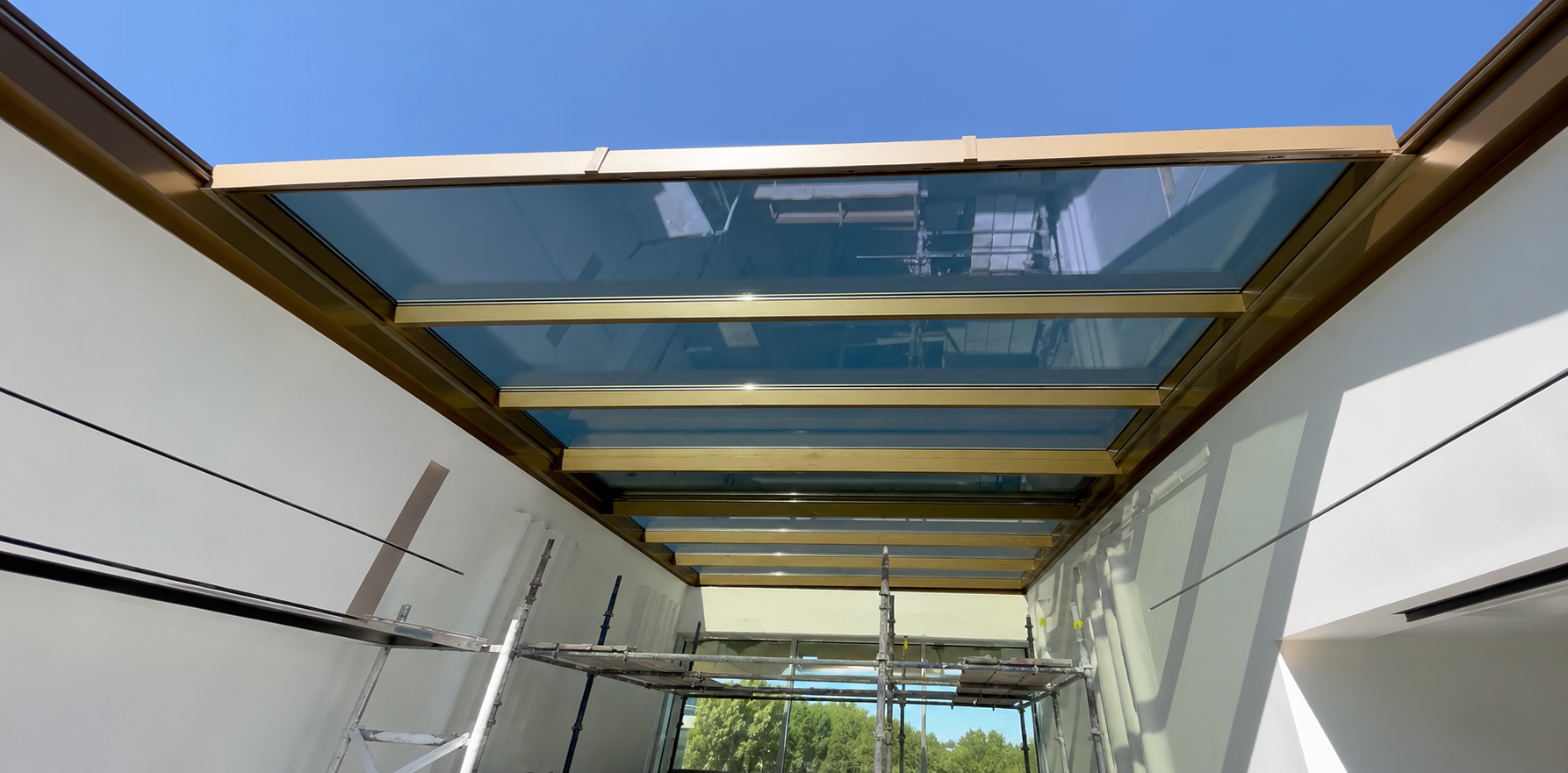
Choosing between an operable skylight and a fixed skylight is not always a straightforward process. Each skylight type has its strengths and considerations, making them best suited for different spatial requirements, applications, and preferences.
That being said, our guide provides you with a comprehensive breakdown of opening vs non-opening skylights, their pros and cons, and which is best for you—assisting you in making the right choice with confidence and ease.
What is an Operable Skylight?
Operable skylights, also known as opening or retractable skylights, are roof skylights that can be opened either manually or automatically, depending on how they operate. They allow natural light to fill the space while also promoting natural ventilation by releasing stale indoor air and letting fresh outdoor air circulate throughout the building.
How Do Operable Skylights Work?
Retractable skylights come in two types: motorised (electric) and manual. Electric models operate via a wall switch or remote control, while manual models are opened and closed using a handle, crank, or control rod.
Discover more: What is an Operable Skylight? Advantages and Reasons to Install One
What is a Fixed Skylight?
A fixed skylight, also known as a non-opening skylight, is a roofing solution that is permanently sealed and cannot be opened. The main function of this skylight type is to illuminate the indoors with sunlight without contributing to natural ventilation. Fixed skylights come in various sizes and shapes, all of which remain closed at all times.
How Do Fixed Skylights Work?
Fixed skylights have no opening mechanism, as they remain permanently closed. They simply allow natural daylight to pass through their transparent panels, with the light either diffused or kept clear depending on the material used.
Learn more: Best Skylight Materials: Types & How to Choose the Right One
Opening vs Non-Opening Skylight: Pros and Con
To fully leverage the benefits of skylight installation, you should carefully explore the pros and cons of opening vs. non-opening skylights so you can decide which is best for you:
Advantages of Opening Skylights
Wondering if you should install a skylight that opens? Below are some of the advantages of opening skylights:
Natural Ventilation
Retractable skylights’ biggest advantage is natural ventilation. When opened, they release hot air trapped near the ceiling while drawing fresh air into the building. When paired with open windows or doors, they create continuous natural airflow.
Improved Indoor Comfort
Operable skylights elevate indoor comfort in several ways. The gentle, natural airflow created by an open skylight often feels more pleasant than the forced air from HVAC systems. They also help remove excess humidity and odours to keep the indoor environment fresher.
Better Air Quality
Another advantage of opening skylights is improved indoor air quality. This is the natural result of releasing stagnant air, excess carbon dioxide, and odours, while helping to remove excess moisture and airborne pollutants.
Improved Energy Efficiency
The use of operable skylights for ventilation and passive cooling significantly reduces reliance on HVAC systems, minimising energy consumption and lowering bills.
Convenient Operation
Opening and closing operable skylights can be easily done using a remote control or a wall switch. Some advanced retractable skylights also feature sensors that automatically close as soon as rainfall begins.
Supports Passive Cooling
It is worth noting that retractable skylights are used for ventilation and passive cooling as well. As hot air escapes through the open skylight, cooler, fresh outdoor air replaces it, naturally lowering the indoor temperature without relying on air conditioning.
Disadvantages of Operable Skylights
There are some disadvantages of operable and retractable skylights that you should consider, and they are as follows:
Higher Initial Price
When it comes to the cost of retractable skylights vs fixed skylights, operable models are typically more expensive, as they integrate moving parts, opening mechanisms, and electrical components in motorised skylights.
More Maintenance
Operable skylights generally require more regular maintenance to inspect components such as hinges, seals, and motors, ensuring the opening mechanism continues to operate smoothly and efficiently.
Potential for Air Leakage
Since operable skylights have moving parts, unlike fixed skylights, they are more likely to leak air into the building if the movable components wear out or if the skylight is not installed properly.
Greater Risk of Water Infiltration
Similar to the risk of air leakage, operable skylights have a higher potential for water infiltration if weather seals, flashing, or moving components become worn over time, or if the skylight is improperly installed.
Dependence on Power
When exploring the pros and cons of opening vs. non-opening skylights, it is important to note that motorised, operable skylights need a source of power to operate. This can be an issue during power outages or electrical failures, although many skylight manufacturers address it with battery backup systems and other solutions.
More Complex Installation
Considering how operable skylights work, they tend to have more complex installation processes than fixed skylights. But expert skylight installers ensure smooth and safe installation for reliable, long-term performance.
Learn more: Skylight Installation: Your Complete Guide to the Process & Benefits
If those are the advantages and disadvantages of opening skylights, what about fixed skylights?
Advantages of Fixed Skylights
As part of our breakdown of the pros and cons of opening and non-opening skylights, it is crucial to grasp the fixed skylight benefits for well-informed decision-making. They are as follows:
Maximised Daylight
Fixed skylights are excellent skylights for natural light, as they fill the place with clear or diffused light, depending on the glazing material. The result is a bright, evenly illuminated interior with no glare and enhanced visual comfort.
Enhanced Energy Efficiency
As fixed skylights light up rooms without using power, they reduce electricity consumption. This is a major fixed skylight benefit, especially in commercial and industrial buildings that operate for long periods of time or around the clock.
Less Maintenance
Non-opening skylights have less maintenance needs than operable models because they do not contain moving parts. However, they still need regular cleaning and routine inspections of the glazing, weather seals, and other components to maintain optimal performance and longevity.
Improved Weather Resistance
Since fixed skylights are permanently sealed and have no sashes that open, they are less likely to leak water and air into the building. Meaning? Rainfall falls off the panels smoothly and easily while also protecting the indoors from unwanted air coming through gaps.
Cost-Effective
Regarding the price of retractable skylights vs fixed skylights, the fixed models are more cost-effective, as they do not integrate opening mechanisms, motors, or moveable components. The price can be a major selling point for property owners looking for more budget-friendly options.
Greater Durability
Another fixed skylight benefit is their great durability. While operable skylights are also quite durable, fixed types are more resilient and robust. Such strength is simply the result of having simpler construction and no moving components, so there are fewer parts that can wear out or fail over time.
Disadvantages of Fixed Skylights
There are some disadvantages that you should take into account when it comes to fixed skylights, such as the ones listed below:
No Natural Ventilation
Unlike vented skylights, fixed skylights cannot be opened. Therefore, they do not provide natural ventilation or promote indoor airflow, meaning that indoor spaces rely more heavily on HVAC systems for ventilation instead of benefiting from natural air circulation.
No Passive Cooling
Fixed skylights cannot release the warm air that naturally accumulates near the ceiling. So, they do not contribute to passive cooling. However, the right glazing delivers excellent thermal performance by reducing heat transfer and maintaining a comfortable indoor temperature.
Limited Functional Versatility
Fixed skylights are the ideal skylights for natural light, as they are installed to serve one primary purpose: bringing daylight into a space. But they cannot be used for ventilation or passive cooling, making them less functionally versatile.
Not Suitable for Ventilation-Dependent Spaces
Fixed skylights may not fit spaces heavily dependent on ventilation—think indoor pools, spa areas, bathrooms, kitchens, attics, and sunrooms. Those areas benefit more significantly from opening skylights to prompt natural airflow for a more comfortable environment and improved air quality.
No Emergency Ventilation
Fixed skylights cannot provide ventilation in cases of emergency like power outages and HVAC downtime. This is unlikely to be a concern in most applications, but it may be a limitation in spaces such as kitchens, bathrooms, lofts, or workshops, where natural ventilation is sometimes desirable.
As such, we concluded our opening vs non-opening skylights’ pros and cons breakdown.
Operable Skylights vs. Fixed Skylights Comparison: Key Differences
Here is a brief and straightforward skylight comparison between operable and fixed skylights, demonstrating their key differences:
| Aspect | Operable Skylight | Fixed Skylight |
|---|---|---|
| Ventilation | Provides natural airflow | No ventilation |
| Natural Light | Provides daylight | Provides daylight |
| Energy Efficiency | Available with energy-efficient glazing | Available with energy-efficient glazing |
| Humidity Control | Helps reduce humidity through airflow | Does not reduce humidity |
| Installation | More complex | Simpler |
| Maintenance | More complex | Simpler maintenance |
| Durability | Durable with proper maintenance | High durability due to no moving parts |
| Weather Resistance | Good, but depends on seals and mechanisms | Excellent due to sealed design |
| Automation | Available with motorised and smart controls | Not applicable |
| Ideal Applications | Spaces requiring daylight and ventilation | Spaces requiring daylight only |
| Cost | Higher | Lower |
Fixed or Operable Skylights: Which Skylight Type Should You Choose?
The skylight type that is best for you depends entirely on your needs and the building’s requirements. Below is a straightforward framework guiding your choice:
Choose an Operable Skylight If You Need Ventilation
Operable models are best suited for kitchens, bathrooms, living spaces, and areas where humidity control is necessary, like laundry rooms, greenhouses, pools, and wellness facilities—to mention a few.
Choose a Fixed Skylight If You Need More Natural Light
If daylight is the priority, go with fixed skylights. They are ideal for hallways, stairwells, living rooms, and spaces where ventilation is not a priority.
For Residential Projects
Operable and retractable skylights work well in homes where fresh air circulation is desired, while fixed skylights are sufficient for residential places requiring only natural daylight.
For Commercial Buildings
Fixed skylights are best for areas needing only natural light, but opening skylights are best suited for buildings requiring natural ventilation as well for maximum comfort.
For Hospitality and Luxury Spaces
Operable skylights can enhance guest comfort through ventilation and automation, while fixed skylights create bright, open interiors. Your choice depends on the type of place you have and the occupants’ needs.
Read more: Commercial Skylights: How to Choose the Best One?
FAQs about Opening and Non-Opening Skylights
Here are the most common questions and their answers:
Can operable skylights be integrated with smart home systems?
Yes, motorised skylights can be integrated into smart home platforms, so they can be opened and closed through mobile applications or voice assistants.
Are operable skylights secure against break-ins?
Yes. Operable skylights are completely safe against break-ins when they are closed, as they are designed with robust locking mechanisms. Many operable models also incorporate reinforced frames for added security. Keep in mind that locking the skylight when not in use is essential for safety, too.
Do fixed and operable skylights use the same glazing options?
Yes. Both fixed and operable skylights are available with the same glazing options like low-E coatings, double or triple glazing, and laminated glass. The main difference lies in the opening mechanism—or lack thereof.
Can fixed skylights be converted into operable skylights later?
No. Fixed skylights cannot be transformed into operable models because they are manufactured with different frames, opening mechanisms, and sealing systems. Upgrading usually means replacing the entire skylight.
What should you consider before choosing a skylight?
Whether you are getting an opening or non-opening skylight, it is important to consider factors like ventilation requirements, roof design, glazing type, room’s purpose, and budget before proceeding.
Fixed and Operable Skylights from Almamary
Want to install a skylight that lasts you decades to come?
Whether you are considering a fixed skylight or an operable, retractable skylight, Almamary is your trusted skylight manufacturer in the MENA region. With decades worth of experience, Almamary provides you with modern skylight models in different shapes and sizes, made only of the best materials and glazing options.
Almamary handles your skylight project from beginning to end, ensuring long-term functionality and excellent performance—no matter whether the skylight opens or not.
Consult our team to begin.